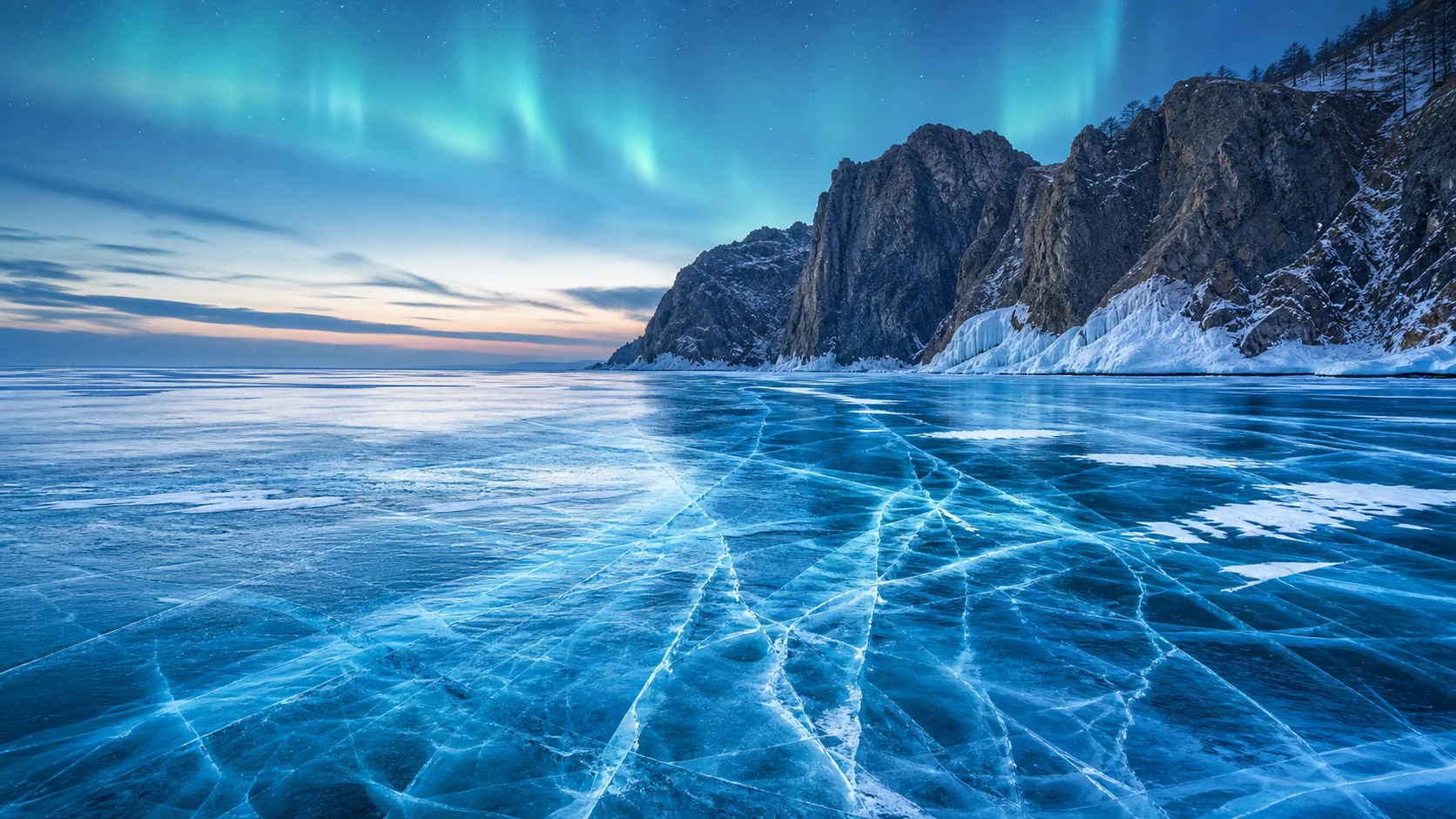
The most balanced window for mature ice, daylight and workable routes on a first visit.
15.02
—10.03The first-choice window for most travellers
—10.03The first-choice window for most travellers
The short answer
Prioritise mid-February to early March
This period usually offers the best balance of mature ice, blue-ice and grotto scenery, longer daylight and workable winter routes.
It is not a guarantee of perfect blue ice. Snow can cover clear ice, wind redistributes snow, and dynamic cracks may delay, reroute or close official access. Good planning still checks conditions every day.
START HERE · First-trip snapshot
Understand a Lake Baikal trip in 30 seconds
Lake Baikal is not a single stop that can be explored casually after arrival. A winter trip normally uses Irkutsk as the gateway, then divides time between Listvyanka, Olkhon Island and the Small Sea. Transport, permits and live ice conditions shape each day.
Enough for Irkutsk, Listvyanka and Olkhon's north and south routes, with some flexibility.
Flights from Kuala Lumpur normally require a connection, followed by overland travel to the lake.
UNESCO lists Baikal as a World Heritage site and describes it as the world's oldest and deepest lake.
As of August 2026, Malaysia is eligible for Russia's unified e-visa and Irkutsk is an approved checkpoint.
Protected routes in Pribaikalsky National Park require an official entrance permit.
VIDEO · See it in 49 seconds
See the blue ice before choosing your month
This short compares January's new ice, February's fuller range of ice scenery and the longer daylight of early March. Use it to understand the setting, then rely on current official ice-road notices, snowfall and local guide assessments before travelling.
Beyond Travel field video · YouTube Shorts
BLUE ICE · Light and thickness
Why does the ice look blue?
Blue ice is not coloured ice. In thick, clear ice, longer red wavelengths are absorbed more strongly while blue light is more likely to return to the eye. Fractures, trapped bubbles and layers create shifting shades and textures.
Baikal's winter story is more than one blue surface. Spray freezes into curtains and pillars, expanding ice forms fractures, and bubbles are trapped in selected areas. Sun, snow and viewing angle can make different parts of the lake look completely different on the same day.
ICE ATLAS · Read the ice in photos
How are blue ice, bubbles, fractures and grottos different?
Social media often labels every winter scene as blue ice, but the lake presents several distinct ice forms. Knowing the difference helps you read itineraries accurately and avoids expecting every stop to look identical.
Clear blue ice
Thick, clear ice with fewer bubbles can look deep blue or blue-black. Snow may hide the mirror surface without changing the ice below.
Bubble ice
Bubbles trapped in successive freezes form white discs or columns and are more common in selected shallow or gas-active areas.
Fractures and pressure ridges
Temperature shifts and ice movement create white lines, open cracks or pressure ridges. Only professionals should distinguish photogenic textures from hazards.
Grottos, curtains and icicles
Repeated freezing of spray and seepage creates curtains, pillars and grotto-like spaces whose form and access change each year.
MONTH-BY-MONTH · Seasonal archive
How do January, February and March differ?
Temperatures below aggregate NASA POWER daily data for Khuzhir coordinates from 2001–2020 and show average daily highs and lows. They are climate references, not trip forecasts. Daylight is an approximate mid-month value near 53°N.
| Factor | January | February | March |
|---|---|---|---|
| Long-term avg daily high / low | −20.4°C / −28.1°C | −15.3°C / −25.5°C | −4.6°C / −14.3°C |
| Approx. mid-month daylight | 8.3 h | 9.9 h | 11.8 h |
| Typical ice stage | New ice; large local differences | Mature ice; best all-round balance | Still mature early; faster change toward month-end |
| Photography | Clear new ice possible; short shooting window | Varied blue ice, cracks and grottos | Longer, stronger light; easier outdoor shooting |
| Route reliability | Lower; official ice road may not be open | Usually most established; live checks still essential | Often good early/mid-month; rising late-month risk |
| Best for | Cold-ready photographers who accept rerouting | First-timers seeking the widest range of ice scenery | Travellers prioritising light, photos and milder cold |
Data note: NASA POWER daily climate data, 2001–2020. Wind, humidity, exposure time and clothing strongly affect how cold it feels.
01New Ice / 新冰
January: the newest ice, and the most uncertainty
With sustained cold, little snow and calm water, new ice may look exceptionally smooth and deep blue. But Baikal is vast, and freezing differs around river mouths, straits and shorelines. Ice at the shore does not mean vehicles can safely enter the lake.
StrengthFewer crowds, clean new-ice textures and the strongest deep-winter mood.
LimitationExtreme cold, short daylight and possible ice-road delays demand flexibility.
02Mature Ice / 成熟冰
February: the best all-round mix of ice and activities
Sustained cold gives the ice more time to thicken and coastal icicles and grottos more time to develop. Clear ice, white fractures, bubble ice and pressure ridges often appear across different stops, making February the easiest month to plan for a first comprehensive visit.
StrengthThe widest variety of ice scenery and usually established winter operations.
LimitationTemperatures can remain below −20°C; peak crowds and snowfall can obscure clear ice.
03Long Light / 长日照
Early March: better light, photography and comfort
March does not mean instant thaw. Early March remains an important blue-ice period, while longer daylight, a higher sun angle and milder temperatures make portraits, low-angle fractures and sunset photography easier. The bigger concern is travelling too late, when above-freezing conditions, surface water, deformation and closures become more likely.
StrengthNearly 12 hours of daylight, milder conditions and the longest shooting window.
LimitationLate-month plans rely heavily on live notices; wind can still make conditions severe.
DECISION · How to choose
There is no single best month — only the best fit for you
These date windows guide planning; they are not safety guarantees. Final routes must follow official ice-road and national-park notices, snowfall and local guide assessments.
FIRST TIME
First visit: mid-February to early March
Prioritise a complete range of ice scenery and established winter logistics over extreme cold.
PHOTO & COMFORT
Photography: early March
Longer daylight and milder temperatures suit portraits, short video, sunrise, sunset and longer outdoor sessions.
NEW ICE & QUIET
New ice: late January
Best for cold-ready travellers who accept hovercraft or land alternatives and last-minute changes.
ROUTE · From Malaysia
How should a Lake Baikal route from Kuala Lumpur be planned?
Schedules change by season. The durable planning principle is to use Irkutsk as the international gateway, then organise the lakeshore and Olkhon by distance. Beyond Travel's current nine-day product routes Kuala Lumpur via Beijing to Irkutsk; final flights remain subject to confirmation.
Kuala LumpurDepart KUL with a sensible connection window.
Asian hubCheck baggage, transit and terminal arrangements.
IrkutskThe gateway for supplies, acclimatisation and lake transfers.
Lakeshore & OlkhonUse overland, hovercraft or approved ice-road routes as conditions allow.
About 70 km · about 1 hour
Suitable for a first lakeside experience, the Baikal Museum, fish market and hovercraft activities. Winter roads and stops affect timing.
About 257 km · about 5.5 hours
This is a long transfer day. Weather, meals, vehicle changes, crossings and ice-road status may add time, so avoid overloading arrival day.
South for ice · north for landscapes
The south often combines clear ice, bubbles and grottos; the north focuses on dramatic cliffs such as Cape Khoboy. Exact access changes yearly.
| Length | Best for | Realistic scope |
|---|---|---|
| 6–7 days | Time-limited travellers | Irkutsk plus one main lake area; Olkhon transfers take a large share of the trip. |
| 8–9 days | First visit from Malaysia | Irkutsk, Listvyanka and Olkhon's north and south routes, with some flexibility. |
| 10+ days | Photography or slower travel | Add sunrise and sunset sessions, a weather buffer, villages or a longer Irkutsk stay. |
REALITY CHECK · What changes on the ground
Why might the perfect blue ice in photos not appear?
01
Snow cover: clear ice may be underneath, but the mirror effect disappears.
02
Local differences: Listvyanka, Olkhon, the Small Sea and other shores can look different on the same day.
03
Flat light: the ice can remain clear, yet look less blue than under low-angle sunlight.
04
Photography choices: low angles, wide lenses, polarisers and editing intensify blue tones and fractures.
05
Year-to-year variation: warm winters, wind, freeze-up timing and dynamic cracks alter where access is possible.
SAFETY · Safety first
Thick-looking ice is not safe everywhere
River mouths, straits, currents, hot springs, cracks and underwater gas can create local thin ice. Seeing another vehicle pass is not a safety assessment, and an open official ice road applies only to the designated route under current conditions.
How do accidents on Lake Baikal ice usually happen?
High-risk situations are rarely the whole lake suddenly failing. They more often involve leaving an approved route, entering local thin ice, attempting to cross an active crack, or relying on yesterday's judgement after warming and melt. The essential safeguard is to follow today's official access and guide instructions, never colour, temperature or personal guesswork.
A real 2026 warning
In February 2026, Russia's emergency authority in Irkutsk reported that the planned Olkhon ice crossing did not open after a dynamic crack formed at kilometre four. From 23 March, the North Olkhon route closed due to sustained above-freezing daytime temperatures, icing and melt risk. Last year's pattern can never replace today's notice.
PHOTO · Phone and camera
How do you photograph blue ice without taking risks?
Blue-ice colour depends on clarity, light direction and camera angle. A strong image never requires approaching an unchecked crack; low angles, side light and foreground within the guide's safe zone create depth.
Use low side light
Slanting morning or afternoon light reveals fractures and layers; overcast light shows texture but often less blue.
Protect snow highlights
Check that snow is not blown out. Lower phone exposure slightly or use the camera histogram to retain ice texture.
Keep spare batteries warm
Severe cold drains batteries quickly. Keep power banks and spares in an inner pocket, and bag equipment before going indoors to reduce condensation.
Do not over-polarise
A CPL reduces glare, but too much can erase surface character or make a wide sky uneven. Recheck it after every angle change.
Never frame while walking backwards
Slippery ice, cracks and ridges are easy to miss. Stop, check footing, then compose, and keep everyone within the guide's boundary.
Check current drone rules
Park, border, airport and airspace rules may restrict flights. Old online reports are not permission; confirm with the operator and authorities.
PACKING · From Malaysia
Warmth comes from correct layers, not one huge coat
Wind chill, standing still and filming on an open lake can feel far colder than the number on a forecast. Clothing must move moisture, trap heat, block wind and leave room for hands and feet to move.
01 · BASE
Moisture-wicking base
Thermal underwear; avoid cotton that stays wet and cold.
02 · MID
Insulating mid-layer
Fleece, wool or light down that can be adjusted.
03 · SHELL
Windproof outer shell
Long down coat with windproof snow trousers.
04 · EXTREMITIES
Hands, feet and face
Insulated boots, wool socks, windproof gloves, hat and neck gaiter.
Ice cleatsSunglassesSunscreenHand warmersSpare batteriesInsulated flaskLip balm
ENTRY · Visa, permits and documents
What should Malaysian passport holders arrange?
The information below was checked against official sources on 9 August 2026. It does not replace final decisions by the Russian Foreign Ministry, embassy, airline or border authority. Recheck both before payment and departure.
Malaysia is on the eligible-country list
Russia's Foreign Ministry e-visa site lists Malaysia as eligible, and Irkutsk International Airport as an approved checkpoint. Apply through the official system and do not rely only on third-party summaries.
Current limits: 120-day validity, 30-day stay
The Foreign Ministry FAQ says that from 23 August 2025, a unified e-visa is valid for up to 120 days from issue and allows a stay of up to 30 days. Your issued visa controls the actual dates.
Confirm migration registration
Hotels normally handle migration registration. If not staying at a hotel, the official FAQ says the host must arrange it within seven working days of arrival. Keep copies of passport, visa and registration.
Protected Olkhon routes require permits
Pribaikalsky National Park provides entrance permits and official route information online. Confirm who obtains the permit, which north or south sections it covers, and the closure alternative.
Insurance should cover winter activity and medical care
Confirm that Russia, winter outdoor activity and medical evacuation are covered, and disclose pre-existing conditions. Older travellers or those with heart, lung or joint issues should consult a doctor before booking.
Carry online and offline documents
Save passport details, e-visa, insurance, accommodation, onward ticket, park permit and emergency contacts, with offline or paper copies beyond the phone.
Malaysia's Embassy in Moscow also advises Malaysian visitors to verify visa requirements with the Russian Embassy in Malaysia.
FAQ · Before you book
Lake Baikal blue-ice questions
Which month is best for Lake Baikal blue ice?
For most first-time visitors, mid-February to early March is the best balance. Choose February for the widest variety of mature ice, or early March for longer daylight and milder conditions.
Is Lake Baikal already frozen in January?
Parts of the lake are usually frozen, but conditions vary widely. Especially in early January, shore ice does not mean an official ice road is open.
Is February or March more beautiful?
February usually wins for grottos, icicles and variety; early March wins for longer, stronger light and photography comfort. Snow can obscure mirror-like ice in either month.
Can I still see blue ice in late March?
Some years still offer blue ice, but the risk of closures, surface water and rapidly changing conditions rises. If blue ice is the priority, do not choose very late dates only for a cheaper fare.
Can older travellers join a blue-ice tour?
Healthy older travellers with stable mobility can consider it, with shorter wind exposure, ice cleats, non-slip boots and enough rest. Anyone with cardiovascular, respiratory or serious joint conditions should consult a doctor first.
How do I get to Lake Baikal from Malaysia?
Trips normally connect from Kuala Lumpur through an Asian hub to Irkutsk, then continue overland to Listvyanka or Olkhon. Beyond Travel's current nine-day product connects via Beijing, but final confirmed flights govern.
Do Malaysian passport holders need a visa for Russia?
As of August 2026, Malaysia is eligible for Russia's unified e-visa and Irkutsk is an approved checkpoint. Rules can change, so recheck the official Foreign Ministry site and embassy before payment and departure.
Do Olkhon Island routes require a park permit?
Parts of Olkhon lie within Pribaikalsky National Park, whose protected routes require an entrance permit. Confirm who obtains it, the route covered and keep a copy.
How many days are best for a Lake Baikal blue-ice trip?
One lake area can fit into six or seven days. For a first trip from Malaysia, eight or nine days better covers Irkutsk, Listvyanka and both Olkhon routes with flexibility.
How can accidents on Lake Baikal ice be avoided?
Never enter unapproved ice or treat another vehicle as proof of safety. Use an experienced legal operator, check official notices daily, and accept hovercraft, overland alternatives or cancellation.
BEYOND TRAVEL · LAKE BAIKAL
Choose the right month —
then put safety before the photo
Explore our 9-day Lake Baikal blue-ice journey, or WhatsApp our advisor for departures, routing and live ice-condition planning.